%20(3).jpg)
WHY PERENNIAL RICE DEVELOPED IN CHINA IS A BIG DEAL?
- Public Vocal
- Dec 7, 2022
- 2 min read

Updated: Feb 20, 2023
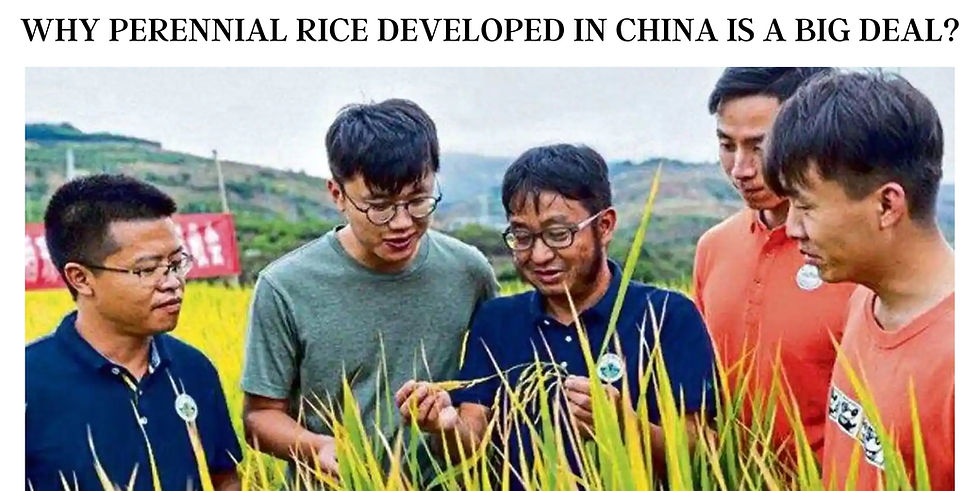
Farmers in China are now growing a perennial variety of rice which does not need to be planted every year. The invention could transform rice farming by making it climate-friendly, besides using less of labor and other inputs.
What is the perennial variety of rice?
Perennial rice named PR23 is developed by cross-breeding regular annual rice Oryza sativa with a wild perennial variety from Africa. Unlike regular rice which is planted every season, PR23 can yield eight consecutive harvests across four years(as these plants with stronger roots grow back vigorously after each harvest). PR23 yields, reported at 6.8 tons per hectare, are comparable to regular irrigated rice. But growing it is much cheaper since it requires less labor, seeds, and chemical inputs. In 2021, the variety was grown by more than 44,000 farmers in southern china.
Does it have any other benefits?
Growing perennial rice over a period of four years resulted in remarkable environmental benefits such as soils accumulating close to a ton of organic carbon (per hectare per year) along with increases in water
available to plants. The perennial varieties were preferred by farmers since it saved 58% in labour and 49% in other input costs, over each regrowth cycle. The researchers claim it can transform farming by improving livelihoods, enhancing soil quality, and by inspiring research on other grains.
Why is the discovery of the new variety significant?
Rice feeds about half of the world, and its farming and consumption are primarily in Asia. Most crops grown today were once perennial but bred to be annual, short-duration, to make them more productive. Perennial rice could be a transformational innovation if it proves to be economically sustainable.
What are the learnings for India?
India is the world’s second-largest rice producer, after china, and the largest exporter with a 40% share in global trade. It is grown during both summer and winter crop seasons. Perennial rice can reduce the drudgery of annual transplantation, a back-breaking task, and generate savings on seeds and other inputs. China’s early success has another lesson for India: to raise investments in public research and agricultural sciences. This can help counter the impact of climate change on food security and rural incomes.


Comments