%20(3).jpg)
Social media is rewiring humanity and we are at crossroad of its promise and its perils !
- Public Vocal
- Jan 24, 2023
- 5 min read

Updated: Feb 20, 2023
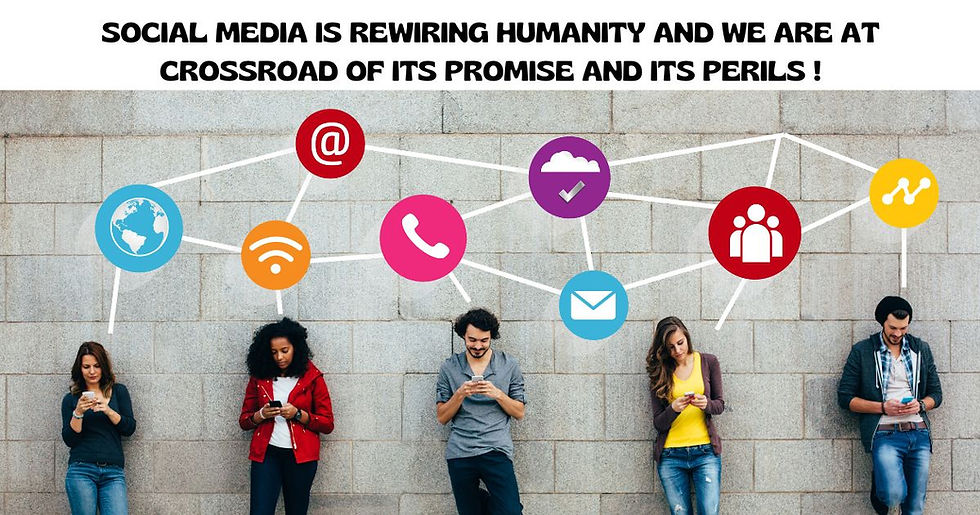
2021 was a strange year. The world braved covid wave after wave. The world stood tall but it was helped in its fight by a very powerful tool of social media. The message laced with hashtags ruled the roast and carried messages of the need for medicines like Amphoteriun or drugs like Hydroxychloroquine far and wide.
Now you would wonder then why I called 2021 strange! While the above paragraph, depicted the strength of social media, revelation by Facebook papers leaked by Frances Hangen depicted the dark side of the same. How Facebook repeatedly ignored the reports suggesting the harmful effects of its media platform on adolescents.
Before we proceed further, let us understand first what is Social Media. Social Media refers to a new way of connection between people pioneered by sites like Orkut, Pinnacled by Facebook, and Instagram which seeks to provide a way to inter-connect via the powerful medium of the internet.
Powered by the vehicle of the internet boosted by 4G, now increasingly 5G they gained a mass following. In India alone, more than 50 million people are on it. Major apps of these include Facebook, Twitter, Messenger, Instagram, and WeChat among others.
Testifying before a senate’s committee, Frances Hangen fervently presented the effect of social media on one life it has rewired humanity.
The question then arises as to how it rewired humanity. The first basic thing happens to be the way we interact. Back in the day, meeting was the norm, today zoom meetings are.
Another major way happens similar to the effect of globalization on the economics of trade. While globalization resulted in economic interdependence, social media resulted in interpersonal interdependence. The fight between T-series and Pew Dew Pie for a greater number of followers was an instance of it.
It has bred a culture of indifference since events are no longer in “real” life but in “reel” life bred an environment of impracticality. An apparent affinity to post videos of suffering to gain followers is one instance.
It has changed the way work was looked upon among humans acting as a vehicle of creative destruction, social media has created a new work culture, attitude, and aptitude among people.
The most basic way social media has rewired humanity is by creating an alter-ego of humans on a digital plane. The schizophrenia visible in individual behavior in “real” and “reel” life is boastingly glaring.
While the question would also be asked whether the growth of social media was inevitable or not, one thing is clear social media fed off on the internet and strengthened the same, creating its own sets of challenges and opportunities.
There are today two schools of thought on whether social media is a bane or a boon. People who have benefited from it like Musk, or the government who promoted noble ideas like Swatchta would say it is good, those lynched because of the spread of fake news would disagree. Let us examine the promise VS peril debate here.
Promise - Real or Reel
Government all over the world uses social media to provide information. The role of the Ministry of Health handles on Twitter disseminating information on covid was one such aspect. Similarly, PM Modi has used his 10 million strong profile on Twitter to drive the home message of Swachchta.
Social media has given rise to social commerce where cheap goods and services can be availed by people through Amazon and Facebook marketplace.
In the social context, social media has helped power the campaign of #MeToo to combat harassment. Similar examples abound in the story of Peng Shuai's allegations against Zhang Gaoli of sexual slavery.
In the cultural context, social media has provided an avenue for people to understand and appreciate tribal culture. The campaign to promote “Aadi Mahotsava” on social media is an example of this regard.
Social media has enabled international collaboration. How the UN worked with individual countries to promote an integrated response to covid is one such instance.
Many other areas fruitfully blessed by social media scenes are the news media sector, NGO sector (raising finances), and governance area while sharing best practices.
While many benefits have been counted above, social media is not without its flaw. We shall discuss them now.
As revealed by the Facebook paper by Frances Hangen, social media contributed to increased anxiety and stress and utter consciousness of body image amongst youth which will hurt the perceived demographic dividend.
Social media has given life to a new group of trolls who leaves no stone unturned to turn the life of their dissenter into hell.
Social media via the powerful medium of the internet enables the multiplication and spread of fake news quickly. The spate of lynching incidents in 2019 on account of spreading the entire fake news was a grim reminder of the same.
The entire game of rights enshrined by the supreme court in the famed K.S Pultaswamy about the right to privacy is put to sudden death in the ever-intoxicating need for social media to spread to every dimension of human life.
While privacy compromised by an individual of his own volition may be justified, the role of BIG TECH in monetizing the behemoth of information that is generated by these social media platforms is being questioned. Such expansive access to indifferent BIG TECH into detail of our lives is bound to create problems. We witnessed this in the major controversy regarding the sale of data by Facebook to Cambridge Analytics.
Social media has an ill effect on health as it enhances the exposure time on screen. A study in the UK found the average time lived without specs/lens has fallen dramatically since 2011.
Political hate campaigns being seen on social media giving rise to violence is another problem that social media have to contend with. January 6 insurrection in the USA was planned by right-wing groups on social media.
Thus, social media presents a confounding tale of hits and misses. The question then arises as to how to deal with the problem of social media so that it remains a tool of welfare.
The first would be the acceptance of the fact that social media is not going away. We have to contend with its presence. It can’t and shouldn’t be wished away.
The second step would be strong data protection law in line with the GDPR of the EU. There is a need to strengthen other laws like IPC to deal with crimes spilling from the digital domain to the physical domain.
Another step would be the acceptance of privacy as a virtue in the 21st century and regulating the power of Bog Tech like will regulate social media rules.
Educating the youth on how to navigate the virtual world is also essential to prevent its misuse. This would go a long way to contain the growth of “trolls”.
Whistleblower protection for the likes of Frances Hangen is also the need of the hour.
A thing to be kept in mind is not to over-regulate lest it tramples upon the role of social media as an expression of dissent which is vital in a democracy.
While all these steps are being taken, development in social media stays one step ahead with the growth of METAVERSE.
It is high time, the GOI constituted an educated workforce that is well aware of the growing dimension of social media so that regulations do not fall behind developments.
The need of the hour is to accept the fact that social media is another aspect of the global commons now. The fruitful growth of global common will help to boost the welfare of the world and we need to take it upon ourselves that we deal with social media in the spirit of Vasudhaiv Kutumbakam.


Comments